Since I started my policy of doing my homework in advance, I feel like I have all the time in the world. It's an incredible feeling. I'm taking 15 credit hours, and I feel like I have time to spare. I'm ahead in all of my classes, I'm working to get even farther ahead, and I've cleaned all of my dishes in the sink because I can. It's an incredible feeling. I thought I'd list some ideas as to where all this time came from, because I've never had it before.
First and most importantly, I don't eat meals in the cannon center anymore. That place ate up nearly an hour and a half a meal, at least. I now spend about 15 minutes a meal. That's an incredible amount of time right there.
Second, I don't have a girlfriend. Girlfriends are fun, and great, but they take up a LOT of time. I had a girlfriend for all of my previous semesters.
Third, I don't have guys down the hall constantly playing videogames and sucking me into their world. That's probably nearly as much time as the cannon center. Woot for not playing videogames except like an hour a week. That's a win.
Fourth, I think I'm taking a slightly easier 15 credits than normal. 5 of those credits are religion classes and orchestra. 6 are microbiology and chemistry, and 4 are hebrew.
Fifth, unlike during the summer, I'm not working a full-time job. In fact, I'm only taking classes. That's it. I have time to do things with my life because of it. It's incredible.
Anyways, I've got to get back to my homework that's not due till next friday. Peace be with you!

Tuesday, September 15, 2009

Thursday, September 10, 2009
Cleanliness
I've never thought of myself as a particularly clean person. In fact, I'm kinda messy. However, since I've gotten back to the Y, I find myself being the clean roommate. My housemates are all excessively messy. The sink is constantly full of dirty dishes. None of them are ever mine, though. I wiped down the countertops in our house, because I just couldn't handle how filthy it was. It was GROSS! I dunno. I find myself being more clean than usual, in the presence of such filth.
Thursday, September 3, 2009
I hate "just friends"
In the past year, I have been in close relationships with two of my friends. I've also felt the pain of ending those relationships. Both times, we ended the relationship by being "just friends". The first time it was my prerogative, the second, it was hers. Both times, though, we were lying. There is no going directly from boyfriend/girlfriend to "just friends" in my experience. When you break up, you go to acquaintance status. You aren't really even friends anymore without some serious work. No matter how much I would like to be friends with them still, it hasn't worked for me. I went through a period of avoiding them, or them avoiding me or both, then slowly became friends again. I still feel robbed of one of my best friends because we broke up under not the best circumstances.
My first girlfriend, Clarissa, put it best. When you break up, it's like you jump off a cliff. You don't walk back the way you came, you jump straight off a cliff. Suddenly, you're at the bottom, hardly even friends, if that. You have to work to get to that "just friends" you talked about.
My first girlfriend, Clarissa, put it best. When you break up, it's like you jump off a cliff. You don't walk back the way you came, you jump straight off a cliff. Suddenly, you're at the bottom, hardly even friends, if that. You have to work to get to that "just friends" you talked about.
Wednesday, August 5, 2009
A Creed
I found this on the website freedomforceinternational.org. I found it to be just about in line with what I believe. Please read and comment.
THE CREED OF FREEDOM
INTRINSIC NATURE OF RIGHTS
I believe that only individuals have rights, not the collective group; that these rights
are intrinsic to each individual, not granted by the state; for if the state has the power to
grant them, it also has the power to deny them, and that is incompatible with personal
liberty.
I believe that a just state derives its power solely from its citizens. Therefore, the
state must never presume to do anything beyond what individual citizens also have the right
to do. Otherwise, the state is a power unto itself and becomes the master instead of the
servant of society.
SUPREMACY OF THE INDIVIDUAL
I believe that one of the greatest threats to freedom is to allow any group, no matter
its numeric superiority, to deny the rights of the minority; and that one of the primary
functions of a just state is to protect each individual from the greed and passion of the
majority.
FREEDOM OF CHOICE
I believe that desirable social and economic objectives are better achieved by
voluntary action than by coercion of law. I believe that social tranquility and brotherhood
are better achieved by tolerance, persuasion, and the power of good example than by
coercion of law. I believe that those in need are better served by charity, which is the giving
of one's own money, than by welfare, which is the giving of other people's money through
coercion of law.
EQUALITY UNDER LAW
I believe that all citizens should be equal under law, regardless of their national
origin, race, religion, gender, education, economic status, life style, or political opinion.
Likewise, no class should be given preferential treatment, regardless of the merit or
popularity of its cause. To favor one class over another is not equality under law.
PROPER ROLE OF THE STATE
I believe that the proper role of the state is negative, not positive; defensive, not
aggressive. It is to protect, not to provide; for if the state is granted the power to provide for
some, it must also be able to take from others, and once that power is granted, there are
those who will seek it for their advantage. It always leads to legalized plunder and loss of
freedom. If the state is powerful enough to give us everything we want, it is also powerful
enough to take from us everything we have. Therefore, the proper function of the state is to
protect the lives, liberty, and property of its citizens; nothing more. That state is best which
governs least.
THE CREED OF FREEDOM
INTRINSIC NATURE OF RIGHTS
I believe that only individuals have rights, not the collective group; that these rights
are intrinsic to each individual, not granted by the state; for if the state has the power to
grant them, it also has the power to deny them, and that is incompatible with personal
liberty.
I believe that a just state derives its power solely from its citizens. Therefore, the
state must never presume to do anything beyond what individual citizens also have the right
to do. Otherwise, the state is a power unto itself and becomes the master instead of the
servant of society.
SUPREMACY OF THE INDIVIDUAL
I believe that one of the greatest threats to freedom is to allow any group, no matter
its numeric superiority, to deny the rights of the minority; and that one of the primary
functions of a just state is to protect each individual from the greed and passion of the
majority.
FREEDOM OF CHOICE
I believe that desirable social and economic objectives are better achieved by
voluntary action than by coercion of law. I believe that social tranquility and brotherhood
are better achieved by tolerance, persuasion, and the power of good example than by
coercion of law. I believe that those in need are better served by charity, which is the giving
of one's own money, than by welfare, which is the giving of other people's money through
coercion of law.
EQUALITY UNDER LAW
I believe that all citizens should be equal under law, regardless of their national
origin, race, religion, gender, education, economic status, life style, or political opinion.
Likewise, no class should be given preferential treatment, regardless of the merit or
popularity of its cause. To favor one class over another is not equality under law.
PROPER ROLE OF THE STATE
I believe that the proper role of the state is negative, not positive; defensive, not
aggressive. It is to protect, not to provide; for if the state is granted the power to provide for
some, it must also be able to take from others, and once that power is granted, there are
those who will seek it for their advantage. It always leads to legalized plunder and loss of
freedom. If the state is powerful enough to give us everything we want, it is also powerful
enough to take from us everything we have. Therefore, the proper function of the state is to
protect the lives, liberty, and property of its citizens; nothing more. That state is best which
governs least.
Monday, July 6, 2009
Rupert Murdoch
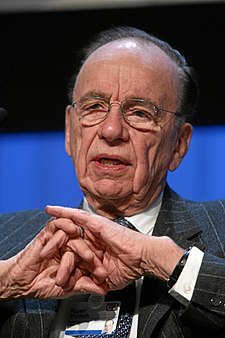


I don't like Rupert Murdoch. The man has FAR too much power. He owns News Corp. also known as Murdoch's News Corp. This company has amongst its subsidiaries ALL of the Fox Broadcasting Company, MySpace, and about a fifth of the newspapers and magazines in the United States.
I read an article today that made me just grimace at the News Corp. Basically, the article states that Fox recently decided to reduce its carbon footprint. Therefore, to help with this, they sneakily stuck global warming messages into their most popular shows, like the Simpson's, Family Guy, 24, etc.
I don't approve. IF Global Warming is a real phenomenon, this is the wrong way to deal with it.
The way that Congress has recently pushed through a multiplicity of bills is also the wrong way to do things. The Cap and Trade bill, (more like Cap and Tax) was 1200 pages long. It was passed through the House of Representatives in something like 1 week. Have you ever read 1200 pages in a week? Have you ever read 1200 pages of legislation in a week? The answer is no. No person can read and comprehend and revise that much legislation in that short of a time. Is Global Warming that urgent? We've been talking about it for nearly 20 years. Would another month hurt that much? I don't think so.
I'm angry at News Corp. I'm angry at Congress. Grumble.
Thursday, June 18, 2009
Global Warming (A Hot Topic)
I read in the Deserted News yesterday that the Western Governor's Association says that the science on Global Warming is done. It's for sure. It's conclusive. I have several questions for these folks.
Question #1: Since when is science EVER conclusive? I've been taught in my science classes all of my life to always doubt the current model. Relativity? It has to be wrong. It's just our best guess so far. Same goes for Quantum Mechanics, Coulomb's Law, AND Anthropogenic Climate Change. Science is not conclusive. Ever. Especially sciences that have been in heavy research for 30 years. If Coulomb's Law has to be wrong, and it hasn't changed in a VERY long time, then Climate Change must follow the same logic. Except that it's a lot newer, and hasn't been quite as conclusively proven.
Question #2: Even if the science is conclusive, are the politics and policy? What evidence do we have that the current proposals to halt climate change will work? For the policy often referred to as "Cap and Trade," we have evidence to the contrary. The Kyoto Protocol was a treaty which took force in February of 2005. It promotes "Cap and Trade" measures between countries. It basically punishes those who increase their CO2 and GHG emissions past 1990 levels by making them pay countries which have decreased their emissions levels. As of 2004, all of 4 major industrial countries have reduced their emissions below 1990 levels. These are the following: The Russian Federation, the UK, Denmark, and Germany. While Germany, Denmark, and the UK are to be commended for their success, the Russian Federation deserves no such glory. Anyone remember what happened in Russia in 1990? Their government, which owned everything, collapsed. Their emissions ratings in that year were exceptionally high due to the fact that their government was still functioning. Since their economy collapsed, it made it rather easy for them to have emissions under 1990 levels. Also, other than these FOUR countries, the vast majority of the 183 signers of the Kyoto Protocol have had increases in their emissions levels. It doesn't seem to have had much effect on emissions levels in any other country, and has simply moved wealth around.
Question #3: Given the failure to achieve the goals of the Kyoto Protocol, why is the United States Government so deadset on doing the same thing here? There must be a better way. One that will actually work, perhaps? If something must be done, I propose to simply pump tax dollars into research grants for developing things that will work.
Hmm... I was going to slip some jokes in here.... I kinda forgot what they were.... or where they went. Oh well. I hope you laughed in some part of this post...
What do you think? I don't see the current proposals as being effectual at preventing Climate Change, assuming the science is conclusive. Do you agree, disagree, or have an entirely different viewpoint? Spell it out! (Thanks for reading, and thank you in advance for your intelligent discourse).
P.S. I am my primary source, with supporting info from http://en.wikipedia.org/wiki/Kyoto_protocol Look at the graph about 3/4 of the way through the article.
Question #1: Since when is science EVER conclusive? I've been taught in my science classes all of my life to always doubt the current model. Relativity? It has to be wrong. It's just our best guess so far. Same goes for Quantum Mechanics, Coulomb's Law, AND Anthropogenic Climate Change. Science is not conclusive. Ever. Especially sciences that have been in heavy research for 30 years. If Coulomb's Law has to be wrong, and it hasn't changed in a VERY long time, then Climate Change must follow the same logic. Except that it's a lot newer, and hasn't been quite as conclusively proven.
Question #2: Even if the science is conclusive, are the politics and policy? What evidence do we have that the current proposals to halt climate change will work? For the policy often referred to as "Cap and Trade," we have evidence to the contrary. The Kyoto Protocol was a treaty which took force in February of 2005. It promotes "Cap and Trade" measures between countries. It basically punishes those who increase their CO2 and GHG emissions past 1990 levels by making them pay countries which have decreased their emissions levels. As of 2004, all of 4 major industrial countries have reduced their emissions below 1990 levels. These are the following: The Russian Federation, the UK, Denmark, and Germany. While Germany, Denmark, and the UK are to be commended for their success, the Russian Federation deserves no such glory. Anyone remember what happened in Russia in 1990? Their government, which owned everything, collapsed. Their emissions ratings in that year were exceptionally high due to the fact that their government was still functioning. Since their economy collapsed, it made it rather easy for them to have emissions under 1990 levels. Also, other than these FOUR countries, the vast majority of the 183 signers of the Kyoto Protocol have had increases in their emissions levels. It doesn't seem to have had much effect on emissions levels in any other country, and has simply moved wealth around.
Question #3: Given the failure to achieve the goals of the Kyoto Protocol, why is the United States Government so deadset on doing the same thing here? There must be a better way. One that will actually work, perhaps? If something must be done, I propose to simply pump tax dollars into research grants for developing things that will work.
Hmm... I was going to slip some jokes in here.... I kinda forgot what they were.... or where they went. Oh well. I hope you laughed in some part of this post...
What do you think? I don't see the current proposals as being effectual at preventing Climate Change, assuming the science is conclusive. Do you agree, disagree, or have an entirely different viewpoint? Spell it out! (Thanks for reading, and thank you in advance for your intelligent discourse).
P.S. I am my primary source, with supporting info from http://en.wikipedia.org/wiki/Kyoto_protocol Look at the graph about 3/4 of the way through the article.
Sunday, June 14, 2009
Liberalism and Conservatism
I've been thinking lately. (Shocker, right?) Why is it that I call myself a Classical Liberal, and believe in constitutionally limited government, and yet several of my friends call themselves Liberal, and believe in extremely strong government? In the time of Jefferson, I think they would be called conservative. In the days of the founding of the United States, Liberalism meant believing in small government, and natural rights. Conservatism used to mean in favor of conserving the rights of the monarchy and the aristocracy. Monarchy, as a system, believes very little in its people. It believes that a privileged class ought to control most EVERYTHING. Liberalism has come to believe in much the same things, especially in its latest manifestation under President Obama. The GM and Chrysler takeovers are proof of this.
Conservatism has come to mean conserving the rights, freedoms, liberties, and traditions of small government the United States has come to be known for.
This change in meaning of the two words is an advantage to the Liberal movement, and a disadvantage to the conservative movement. This is because Liberal has a connotation of moving forward, while conservative has a connotation of holding back.
Would anyone like to explain how these words switched meanings?
Conservatism has come to mean conserving the rights, freedoms, liberties, and traditions of small government the United States has come to be known for.
This change in meaning of the two words is an advantage to the Liberal movement, and a disadvantage to the conservative movement. This is because Liberal has a connotation of moving forward, while conservative has a connotation of holding back.
Would anyone like to explain how these words switched meanings?
Subscribe to:
Posts (Atom)
